Pengaruh Kepemimpinan Transformasional, Spiritualitas Tempat Kerja, Modal Psikologis, dan Pemberdayaan Eksternal terhadap Kinerja Sekolah Ramah Anak
The Influence of Transformational Leadership, Workplace Spirituality, Psychological Capital, and External Empowerment on the Performance of Child-Friendly Schools
Keywords:
Kepimpinan transformasi, kerohanian tempat kerja, modal psikologi, pemerkasaan, prestasi sekolah mesra kanak-kanak, Transformational leadership, workplace, spirituality, psychological capital, empowerment, child-friendly school performanceAbstract
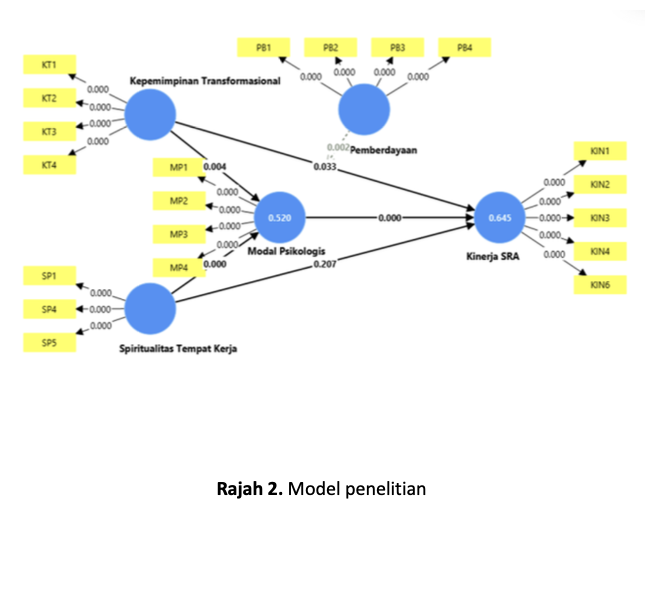
Pemenuhan hak anak di sekolah masih menjadi tantangan krusial dalam pendidikan, karena banyak lembaga belum mencapai kinerja optimal dalam menerapkan Sekolah Ramah Anak (SRA). Studi ini menyelidiki dampak Kepemimpinan Transformasional, Spiritualitas Tempat Kerja, dan Modal Psikologis terhadap kinerja SRA, sekaligus menganalisis peran moderasi Pemberdayaan Eksternal. Menggunakan pendekatan kuantitatif dengan desain kausal, studi ini melibatkan 1.857 guru dari 80 sekolah di Kota Semarang, dengan sampel 175 responden. Data dikumpulkan melalui kuesioner skala Likert lima poin dan dianalisis menggunakan Structural Equation Modeling-Partial Least Squares (SEM-PLS) dengan perangkat lunak SmartPLS 4. Temuan menunjukkan bahwa kepemimpinan transformasional secara signifikan memengaruhi kinerja SRA, baik secara langsung maupun tidak langsung melalui modal psikologis. Spiritualitas di tempat kerja tidak secara langsung memengaruhi kinerja CFS, tetapi memberikan pengaruh tidak langsung melalui modal psikologis. Guru yang dipimpin oleh pemimpin transformasional dan bekerja di lingkungan yang mendukung secara spiritual menunjukkan tingkat harapan, efikasi diri, optimisme, dan ketahanan yang lebih besar, sehingga meningkatkan kinerja sekolah. Lebih lanjut, pemberdayaan eksternal memperkuat hubungan antara kepemimpinan transformasional dan hasil CFS. Hasil ini selaras dengan Teori Penentuan Nasib Sendiri, karena membahas kebutuhan psikologis dasar akan otonomi, kompetensi, dan keterkaitan, yang mendorong motivasi intrinsik. Kesimpulannya, kepemimpinan transformasional, spiritualitas di tempat kerja, dan pemberdayaan eksternal secara kolektif menumbuhkan modal psikologis, yang memainkan peran penting dalam meningkatkan kinerja CFS. Studi ini memberikan wawasan praktis bagi para pembuat kebijakan dan pemimpin sekolah, sekaligus merekomendasikan penelitian di masa mendatang tentang faktor-faktor pendukung tambahan, termasuk dukungan sosial dan kebijakan regulasi.
The fulfillment of children’s rights in schools remains a critical challenge in education, as many institutions have not yet achieved optimal performance in implementing Child-Friendly Schools (CFS). This study investigates the impact of Transformational Leadership, Workplace Spirituality, and Psychological Capital on CFS performance, while also analyzing the moderating role of External Empowerment. Using a quantitative approach with a causal design, the study involved 1,857 teachers from 80 schools in Semarang City, with a sample of 175 respondents. Data were collected through a five-point Likert scale questionnaire and analyzed using Structural Equation Modeling-Partial Least Squares (SEM-PLS) with SmartPLS 4 software. The findings demonstrate that transformational leadership significantly influences CFS performance, both directly and indirectly through psychological capital. Workplace spirituality does not directly affect CFS performance, but exerts an indirect influence via psychological capital. Teachers led by transformational leaders and working in spiritually supportive environments exhibit greater levels of hope, self-efficacy, optimism, and resilience, thereby enhancing school performance. Furthermore, external empowerment strengthens the relationship between transformational leadership and CFS outcomes. These results align with Self-Determination Theory, as they address the basic psychological needs of autonomy, competence, and relatedness, which drive intrinsic motivation. In conclusion, transformational leadership, workplace spirituality, and external empowerment collectively foster psychological capital, which plays a pivotal role in improving CFS performance. The study provides practical insights for policymakers and school leaders, while recommending future research on additional supportive factors, including social support and regulatory policies.