Evaluation of the DDR Method for Developing Technology-Enhanced Learning Frameworks in Higher Education: A Bangladeshi Context
Keywords:
Design Development and Research (DDR), technology-enhanced learning, critical thinking, higher education, BangladeshAbstract
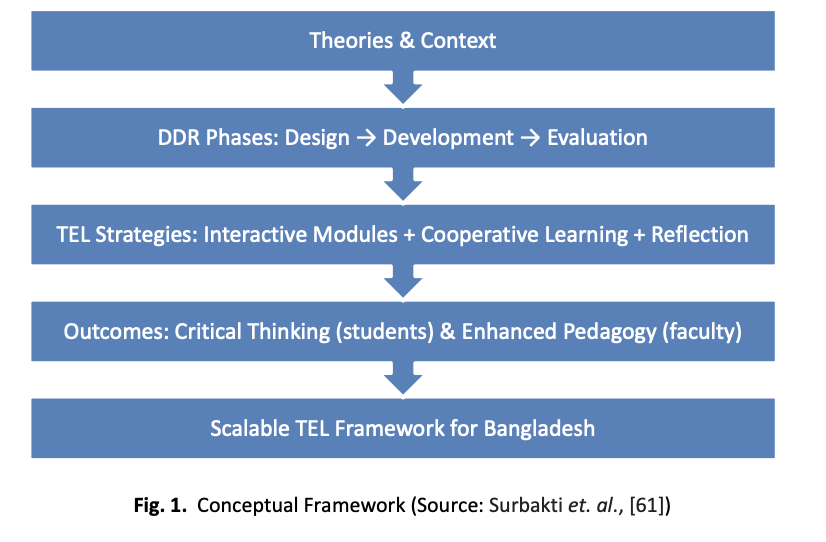
Higher education in Bangladesh is expanding rapidly, but many academes prioritize lecture-based teaching over critical thinking and peddling. This results in a mismatch between learners’ experiences and the competences required by academic and professionals. In response to this challenge, this study examines the application of the Design, Development, and Research (DDR) method to develop a TEL framework for enhancing critical thinking in Bangladeshi tertiary education. The aim of this study is to explore how DDR can be designed and evaluated local perspectives. A qualitative research methodology has been used to reach the objective of this study. After the DDR phase, there were three successive phases in the research: design phase, in which the framework was designed based constructivist and student-centered learning principles, development phase, where interactive digital modules and collaborative activities were developed; and evaluation phase, in which qualitative methods such as focus group discussions, classroom observations and reflective interviews with students and instructors was carried out. The main findings demonstrate that the DDR approach allowed for an iterative process in constructing context-sensitive and adaptable framework. Students commented that technology-based tasks promoted deeper questioning as well as more robust inquiry practices and they felt confident about sharing their diverse opinions. Instructors reported higher levels of classroom engagement and depth of academic conversation in their classes than when they lectured. The main implication is that the DDR approach is useful for the construction of models that enhance learning through technology and helps promote critical thinking in Bangladeshi universities. The originality of this research work lies in its dual application of DDR, not only as an evaluation but also as a design tool being employed in a unique way in the context of the HEIs of Bangladesh.